

For decades, Kyrgyzstan’s sporting infrastructure has been defined by Soviet-era facilities that were never designed for the demands of modern international football. Now, that is about to change.
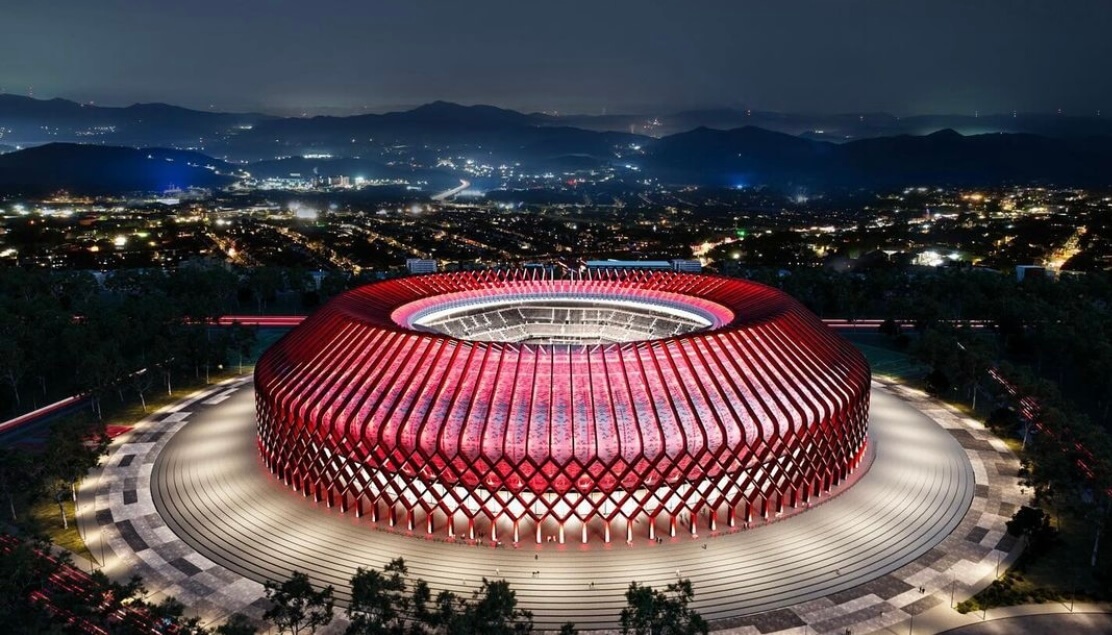
On the southwestern outskirts of Bishkek, the capital of Kyrgyzstan, a vast new stadium is taking shape. Bishkek Arena is being developed as a modern national sports complex
The project is far more ambitious than simply replacing an aging stadium. With an estimated investment of around $60 million and a capacity of 51,000 spectators , the venue is designed to become the largest stadium in Central Asia.
The Stadium Kyrgyzstan Has Been Waiting For
 Source: https://www.eforgroup.com.tr/
The need for a new national stadium has existed for years.
For much of its history, the country’s most important football matches have been played at Dolen Omurzakov Stadium, formerly known as Spartak Stadium. Opened in 1941, the venue has a capacity of around 23,000 and remains one of the most historically significant sporting sites in Kyrgyzstan.
But age has become an increasingly serious problem. Modern international competitions require sophisticated facilities for players, broadcasters, hospitality, security, media and spectators. The standards expected by FIFA and the Asian Football Confederation are considerably more demanding than those of the Soviet period.
The situation became increasingly noticeable as Kyrgyz football began making progress internationally. The national team qualified for the AFC Asian Cup in 2019 and again in 2023, achievements that demonstrated the country’s growing footballing ambitions. Yet success on the pitch created a problem away from it: Kyrgyzstan lacked a modern stadium capable of matching the ambitions of its national team.
The idea of constructing a new national stadium was not new. Proposals had already emerged by the middle of the 2010s, including plans for a large sporting complex near Manas International Airport.
However, these earlier plans failed to develop into a completed project.
The decisive change came under President Sadyr Japarov.
From Political Ambition to Construction
The construction of a new national stadium became a much higher priority after Japarov came to power.
The project was formally announced in 2021 and gained momentum following the national team’s successful Asian Cup qualification campaign in 2022. Renderings of the proposed stadium were subsequently released, giving the public its first impression of what could eventually become Kyrgyzstan’s new sporting centerpiece.
An important moment came in May 2023, when FIFA President Gianni Infantino visited Bishkek. Infantino publicly encouraged Kyrgyzstan to develop a modern football stadium capable of supporting the country’s continued growth.
Political momentum increased further when Kamchybek Tashiev became president of the Kyrgyz Football Union in February 2024. Tashiev, who also holds a powerful position within Kyrgyzstan’s state security structure, brought significant political influence to the country’s football administration. Under his leadership, the development of football infrastructure became an increasingly visible national priority.
A Stadium That Kept Getting Bigger
Perhaps the most remarkable part of Bishkek Arena’s development is how dramatically its planned capacity has changed.
When initial designs appeared in 2022, the stadium was planned as a multi-purpose venue with an athletics track and approximately 22,500 seats.
The design was soon reconsidered. The athletics track was removed and the stadium became football-specific. At the same time, the capacity increased to approximately 35,000 spectators.
But the ambitions did not stop there. By 2023, the proposed capacity had risen again, this time to 45,000. At that point, Bishkek Arena was no longer simply being designed as a replacement for Dolen Omurzakov Stadium. It was being positioned as a major regional venue.
In 2025, Kyrgyzstan’s stadium ambitions became closely connected to a much larger regional project. Kyrgyzstan, Tajikistan and Uzbekistan were pursuing a joint bid to host the 2031 AFC Asian Cup.
Hosting a tournament of that scale would require infrastructure capable of meeting strict AFC standards. One of the most important requirements concerns the largest matches of the competition. The stadium hosting the opening ceremony, opening match and final must have a capacity of at least 50,000 spectators.
Suddenly, a 45,000-seat Bishkek Arena was no longer sufficient for the country’s biggest ambition. In February 2025, project officials announced another expansion. The capacity was increased to 51,000 seats. The new capacity would allow Bishkek Arena to meet the threshold required for the most prestigious matches of a potential Asian Cup.
Architecture Inspired by the Yurt
Perhaps the most distinctive feature of Bishkek Arena will not be its capacity, however. It will be its architecture.
The stadium’s design incorporates visual elements inspired by the traditional Kyrgyz yurt, the circular dwelling historically associated with the country’s nomadic culture.
This is an important symbolic choice. Modern stadiums often attempt to establish a recognizable architectural identity through local culture. In Bishkek, the yurt provides an obvious source of inspiration.
A Symbol of a Changing Kyrgyzstan
Although football is at the heart of the project, Bishkek Arena is expected to serve a much wider role.
A stadium of 51,000 seats can become an important venue for national celebrations, concerts, cultural events and international sporting competitions.
Also the political importance of Bishkek Arena should not be underestimated. For Kyrgyzstan, the project sends a particularly powerful message. The country is attempting to move beyond its reliance on aging Soviet infrastructure and establish facilities capable of hosting modern international events.
The stadium also fits into a broader Central Asian trend. Across the region, governments have invested heavily in new football stadiums, arenas and sporting complexes. Kazakhstan, Uzbekistan and other Central Asian states have increasingly used sports infrastructure as a way of demonstrating modernization and attracting international events. Bishkek Arena places Kyrgyzstan into that competition.
A Target Date With Symbolic Meaning
The planned opening date adds another layer of significance.
Bishkek Arena is expected to be completed in 2026, with an inauguration planned around August 31, Kyrgyzstan’s Independence Day. The date is particularly symbolic because it connects the stadium with national identity and the country’s sovereignty.
It is also linked to the opening ceremonies of the World Nomad Games, an international sport competition dedicated to ethnic sports practiced in Central Asia.
The Bigger Question: Can Kyrgyzstan Fill It?
There is, however, one major question that will remain long after construction is completed.
Can Kyrgyzstan consistently make use of a 51,000-seat stadium? For major international matches, the answer could be yes. A national team competing in Asian Cup qualifiers or other high-profile fixtures can generate enormous interest. A successful bid to host major AFC tournaments would provide another opportunity to fill the venue.
But regular domestic football is a different proposition. Kyrgyzstan does not currently possess the same football market or commercial ecosystem as the major leagues of Europe or even the largest football nations of Asia. A stadium of this size therefore carries significant long-term operating challenges.
Maintenance, security, staffing and utilities all cost money, regardless of whether the stadium is full. This makes the broader development strategy around Bishkek Arena particularly important. The venue will need concerts, cultural events, international tournaments and other activities if it is to operate as a genuinely successful multi-purpose facility rather than a stadium used only occasionally.
A New Chapter for Kyrgyz Football
Nevertheless, Bishkek Arena represents a dramatic change in scale for Kyrgyzstan.
It will become one of Central Asia’s most recognizable sporting landmarks and a major symbol of the country’s modernization.
What do you think about Kyrgyzstan’s new national stadium? Let me know in the comments!
https://youtu.be/Or28tDYX3Hk