Arsenal have abandoned plans for a major expansion of the Emirates Stadium, at least for now. In September 2026, after two years of feasibility work on taking the ground from 60,704 seats towards a reported 70,000 to 80,000, the club chose “continued evolution” over “a huge-scale masterplan”.
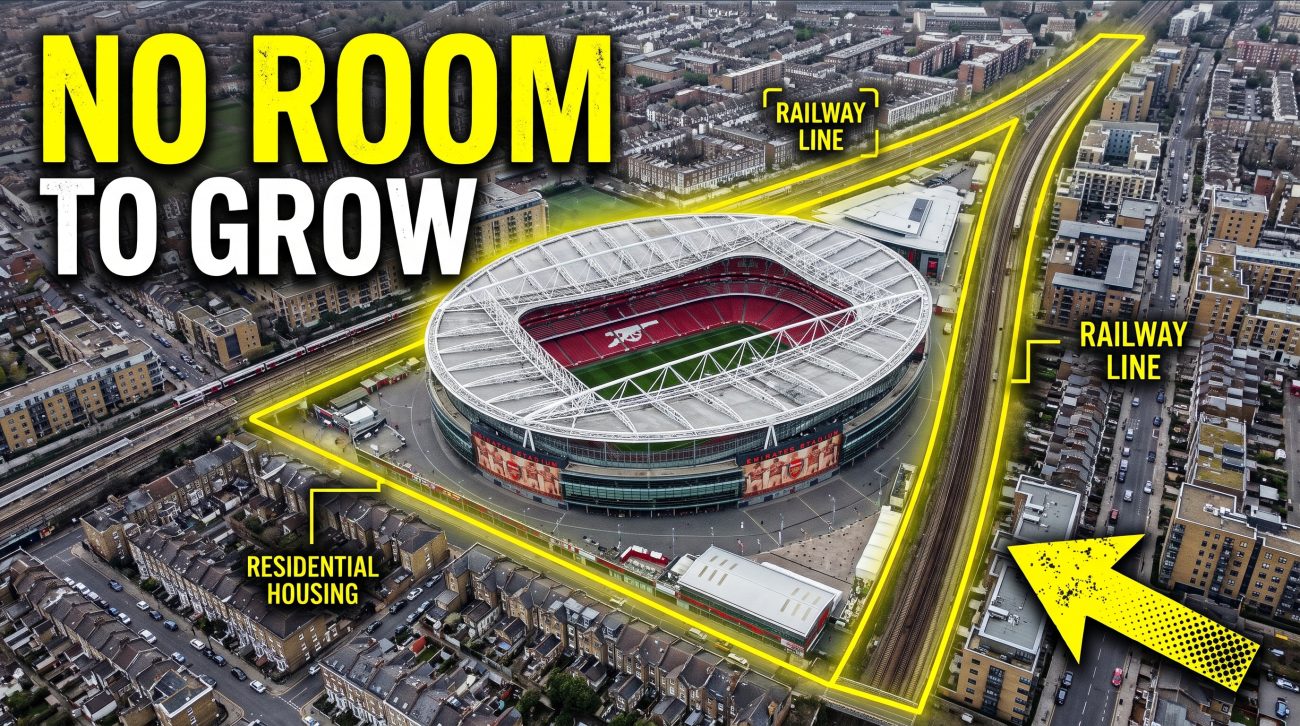
Arsenal has not published its reasons. Reporting by The Times, The Telegraph and The Guardian points to four: a roof that would have to come off, a likely spell of “home” games at Wembley, an uncertain financial return, and manager Mikel Arteta’s reported fear of losing home advantage. Behind all four sit limits that date back to the stadium’s design: a tight site between railway lines and housing, a council height limit, and stations that already struggle on matchdays.
What Arsenal decided in September 2026
Arsenal disclosed the decision at an Arsenal Advisory Board meeting on 24 September 2026. The board is the club’s forum with supporter representatives, and co-chair Josh Kroenke and chief executive Richard Garlick attended. According to the club’s summary, as quoted in the press, Arsenal committed to “continued evolution of Emirates Stadium, rather than a huge-scale masterplan”. Daily Cannon reported that no such masterplan is currently being worked on.
The news became public on 2 October 2026. The Times reported that expansion to a possible 80,000 had been ruled out, and Inside World Football said Arsenal had decided against a significant expansion (Inside World Football).
The wording matters. Arsenal dropped the large-capacity rebuild, but it did not stop investing in the stadium. The club also reportedly hasn’t ruled out modest seat increases
How the Emirates expansion plans developed
The idea went on the record in July 2024. Josh Kroenke told ESPN’s James Olley that “the internal conversations are starting to occur” about the stadium, and called it “not an easy renovation”. A working group was set up that year to study what was possible. By autumn 2024, The Times was reporting that Arsenal wanted more matchday revenue but were unsure how to add seats cost-effectively. The club had hired Populous, the stadium’s original architect, for catering and modernisation work. By December 2024, reports were talking about roughly 80,000 seats.
Coverage peaked on 7 October 2025, when The Telegraph reported a target of more than 70,000 seats and a possible temporary move to Wembley. The Guardian added that Arsenal had not applied to host Euro 2028 matches, reportedly because of the possible redevelopment. ESPN’s sources named three constraints: the 17-acre site, the railway line beside it and Islington Council’s restrictions (ESPN). Three days later the council said it was “not engaged in any formal discussions” with Arsenal (Islington Tribune).
In 2026 the language moved towards renovation. In May, talks with Populous were reported to be at an early stage. Kroenke told the Daily Mail that a plan to renovate the Emirates was being put together. In August, Garlick told BBC Sport that any capacity increase “needs to make business sense”. Five weeks later, the advisory board heard the outcome.
Why the Emirates roof is the biggest obstacle
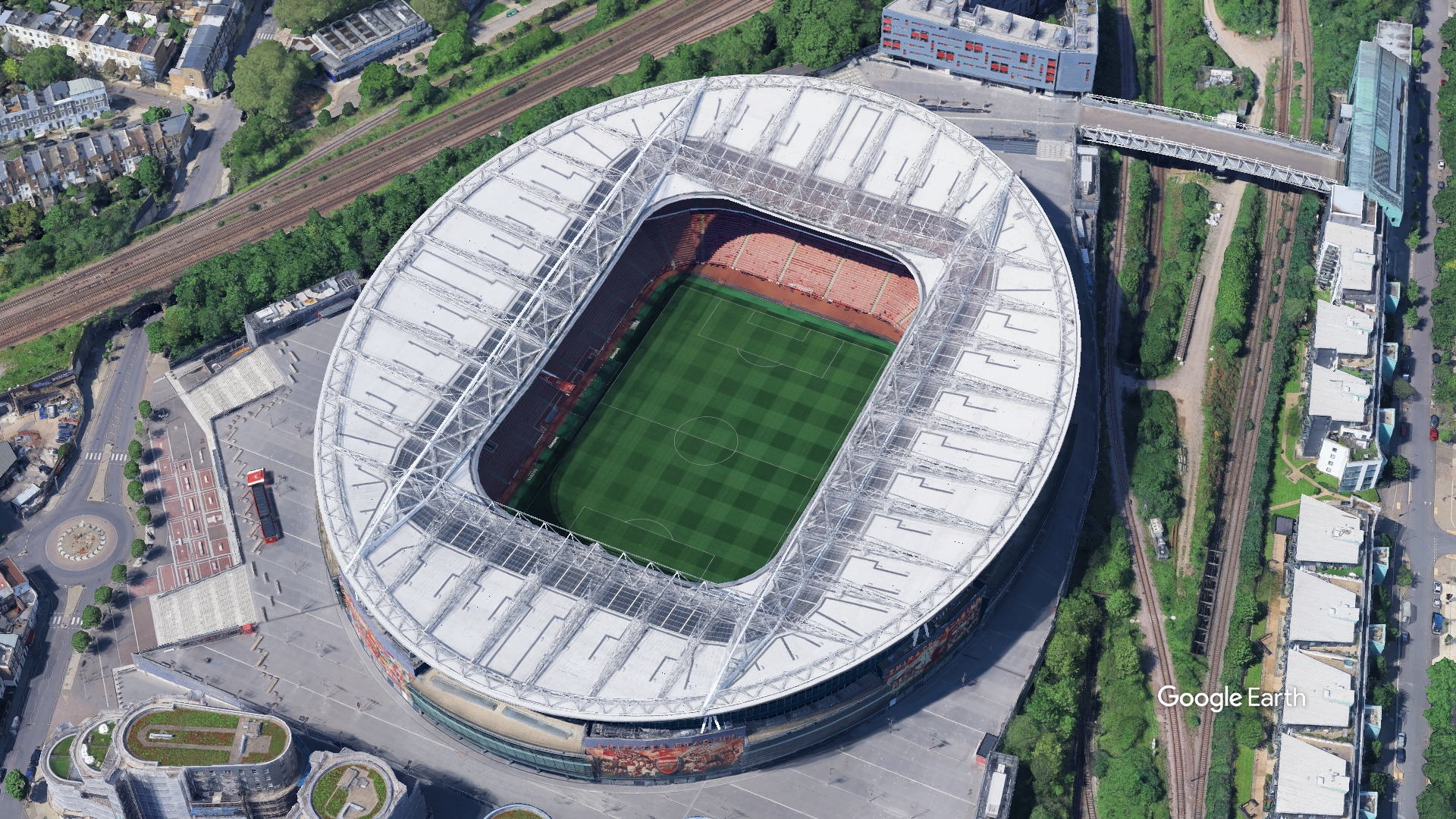
The Emirates roof rests on just eight concrete cores, designed so that it “appears to float above the facade” (Populous). Its two primary trusses each span 204 metres and weigh 720 tonnes. They were assembled on what would become the pitch and lifted onto four corner tripods.
That design makes adding seats very hard. Telegraph reporting relayed by Football Ground Guide said removing and reinstalling the roof “would be enormously expensive”. The same report said smaller seats would have meant upgrading the concourses, and that filling in the corners was also examined.
Outside architects warned about this in December 2024. Nick Tyrer of BDP Pattern, lead designer of Everton’s new stadium, said Arsenal would effectively be adding another small stadium on top. His colleague Jon-Scott Kohli put it this way: “You’re almost building a new stadium, but you’re building it in the air.” He said the cost could run to hundreds of millions.
The roof also explains why Arsenal can’t copy their rivals. Liverpool and Manchester City expanded one stand at a time, with land behind each stand and no continuous bowl roof to replace. At the Emirates, the trusses all meet at the corner tripods, so no single stand can be rebuilt on its own.
Wembley and the fear of losing home advantage
A major expansion would have meant playing some “home” games elsewhere (Inside World Football), and Wembley was the venue most often mentioned. Wembley’s record as a temporary home is mixed. Tottenham averaged 67,953 there in 2017–18 but only 52,584 in 2018–19, and needed special permission from Brent Council to sell all 90,000 seats in the first season (Goal). Arsenal have tried it too: their Champions League home ties at Wembley between 1998 and 2000 drew bigger crowds but produced poor results (StadiumDB).
That history appears to have weighed on the manager. Several outlets relayed a Guardian report that Mikel Arteta advised against expansion because a temporary move would disrupt the club’s routine (Islington Tribune). Arseblog relayed The Times as saying he was wary of losing home advantage (Arseblog News). Arteta has not commented on the record, so his role rests on those reports.
Cost, return and matchday revenue
The Times reported there was no guarantee of a sufficient long-term financial return. The cost most often quoted, about £500m, never came from the club. Construction Wave attributed it to The Telegraph and StadiumDB described the project as worth “up to” that amount. For comparison, the whole original project cost £390m (Ingenia).
The revenue case was shaky too. Telegraph reporting said an internal analysis found 10,000 extra seats could bring in about £100m a year. That works out at about £10,000 per new seat. Arsenal’s current matchday income is roughly £2,500 per seat (£153.9m divided by 60,704 seats), so the estimate only works if most new seats were premium.
The existing ground was already performing. Arsenal made a record £153.9m in matchday revenue in 2024/25, from total revenue of £691m. That beat Tottenham’s £126m from a bigger, newer stadium. StadiumDB’s summary of the club’s thinking is that more income lies in premium areas, catering and retail than in extra seats.
Planning, neighbours and transport
The Emirates was squeezed onto its site from the start. Islington imposed a height limit, and the design team drew more than 100 bowl sections to fit the stadium onto a triangle of land between two railway lines. The area was so built-up that all construction work had to happen within the site itself.
Planning specialists see little room to grow. Josh Risso-Gill of law firm Charles Russell Speechlys described the site as “hemmed in on three sides by residential areas”. Construction Wave reported his estimate that planning consent could take up to five years. His colleague Sadie Pitmans told City AM that raising the roof would likely mean revising the council’s spatial restrictions.
Arsenal have lost to Islington before. In 2014 the club lost a six-day planning inquiry, then a High Court challenge, over its bid to raise its concert allowance from three to six a year. The Emirates is still limited to three concerts and three other non-football events a year. Tottenham has permission for up to 30 major non-football events.
Transport is already stretched. On matchdays, Holloway Road station is exit-only before games and closed for up to two hours afterwards, and Drayton Park station is closed. A major expansion would send another 10,000 to 20,000 fans through the same stations.
How rival clubs expanded their stadiums
The Emirates is now only the seventh-largest football ground in England. The clubs that expanded on their existing site did it one stand at a time. Those that wanted far more seats built next door or moved.
| Stadium (club) | Capacity | How it grew, or why it hasn’t |
|---|---|---|
| Old Trafford (Manchester United) | 74,310 | Plans a new ~100,000-seat stadium next door at “more than £2bn” |
| Tottenham Hotspur Stadium | 62,850 | New build on and beside White Hart Lane for roughly £1bn, with two seasons at Wembley |
| Etihad Stadium (Manchester City) | 61,038 to 61,470 | New North Stand attached to the existing stadium, part of a £300m project |
| Anfield (Liverpool) | 61,276 | One stand at a time: the Main Stand in 2016, then the Anfield Road Stand |
| Emirates Stadium (Arsenal) | 60,704 | Major expansion shelved in September 2026 |
| Hill Dickinson Stadium (Everton) | 52,888 | New waterfront stadium, opened in 2025 |
| Stamford Bridge (Chelsea) | 40,173 | A 60,000-seat scheme approved in 2017 was put on hold in 2018, and the consent has since expired |
The Emirates’ layout, with railways, housing and a continuous roof, has more in common with Stamford Bridge than with Anfield or the Etihad.
Arsenal have been here before: lessons from Highbury
Arsenal faced the same problem at Highbury. After the Taylor Report of January 1990 recommended all-seater stadiums, Highbury’s capacity fell from about 57,000 to under 40,000. It closed at 38,419 (Wikipedia: Arsenal Stadium). In 1997 Islington Council refused an expansion and the East Stand was Grade II listed. A rebuild to 48,000 seats would have meant demolishing 25 houses, and the club dropped it anyway as too small. Over the same years, Manchester United’s gate receipts doubled from £43.9m in 1994 to £87.9m in 1997 after Old Trafford was expanded. Arsène Wenger called the move “that or die” for the club’s future at the top level.
The answer was Ashburton Grove, a rubbish-processing plant and industrial estate about 450 metres from Highbury, identified in November 1999. Islington approved the scheme in December 2001, construction began in February 2004, and the stadium opened in July 2006. The £390m project was funded largely by a £260m loan from a bank group led by RBS. Wenger later called 2006 to 2014 “the biggest period of pressure”, when the club had to sell its best players. The stadium bonds were finally redeemed in July 2020 with a loan from Stan Kroenke’s KSE.
The move solved Highbury’s capacity problem but carried over its geography. Arsenal escaped one boxed-in site by building on another.
What Arsenal is doing instead
Instead of adding seats, Arsenal is trying to earn more from the ones it has. The “evolution” programme includes:
- Catering: Legends runs catering under the “1886 by Arsenal” brand from 2026/27, with mobile ordering.
- Safe standing: in the Clock End this season and the North Bank in 2027/28. The club says this will not add capacity.
- Hospitality: possible new boxes and premium lounges.
- Retail and visitors: a redesign of the Armoury store and an expanded museum and stadium tour (same source).
- Connectivity: better matchday 5G, although Daily Cannon notes that similar promises in August 2025 were not delivered.
Pricing is where the strategy causes friction. Season tickets for 2026/27 rose by 3.9% on average, the fifth rise in a row after a freeze from 2014 to 2022. A new A+ category puts some general-admission match tickets at £90 to £168. The Arsenal Supporters’ Trust called that “by far the most expensive general admission price in English football“. At the top end, Touchline Club hospitality costs up to £5,899 a person for a single match. The club says it has no plans to cut general-admission seats or move supporters to make room for hospitality.
Is the Emirates expansion dead for good?
Not necessarily. As of November 2026, capacity remains 60,704 and no reversal has been reported. The club’s own wording, that no masterplan is currently being worked on, leaves the door open. By Arseblog’s count, just 2,147 more seats would take the Emirates past Tottenham. StadiumDB points to Benfica, which added about 3,000 seats at the Estádio da Luz with pitch-level rows, as the kind of modest step still possible.
Opinion on the decision is split. Critics point to demand. Every men’s home game sells out, and ESPN’s sources put the season-ticket waiting list above 100,000. Football Ground Guide’s Lewis Blain warned that the club “cannot afford to let short-term caution become a long-term competitive disadvantage”.
Others see a sensible calculation. Arseblog’s Andrew Allen called the phased approach more practical, arguing that the cost and disruption of 15,000 to 20,000 extra seats would outweigh the return. The Arsenal Supporters’ Trust’s main concern was protecting general-admission places. After the meeting it told members there were no current plans to move or reduce them, and urged them to stay vigilant (same source).
The next test is Arsenal’s 2025/26 accounts, likely to be published in early 2027, which will show whether matchday revenue is holding at about £154m without new seats.
Frequently asked questions
What is the capacity of the Emirates Stadium?
The Emirates holds 60,704. Its record attendance is 60,383, against Wolves on 2 November 2019.
Did Arsenal cancel the Emirates expansion?
Arsenal shelved a major expansion in September 2026 and chose to keep upgrading the existing stadium. The club reportedly hasn’t ruled out modest seat increases.
Why can’t Arsenal expand the Emirates?
The roof is the main obstacle. It sits on four large steel trusses that meet at the corners, so adding seats would mean replacing it. The site is also boxed in by railway lines and housing, and nearby stations are already restricted on matchdays. A major rebuild would also have forced Arsenal to play home games elsewhere, most likely at Wembley.
How much would expanding the Emirates cost?
Arsenal never published a figure. Press reports put it at about £500m, and architects said it could run to hundreds of millions. The original stadium project cost £390m.
Which English stadiums are bigger than the Emirates?
Wembley, Old Trafford, the Tottenham Hotspur Stadium, the London Stadium, the Etihad and Anfield are all bigger, which makes the Emirates seventh in England.
Will Arsenal build a new stadium?
No credible report suggests a move to a new site. The options Arsenal studied all involved reworking the Emirates, and the club has chosen to keep improving it instead.