
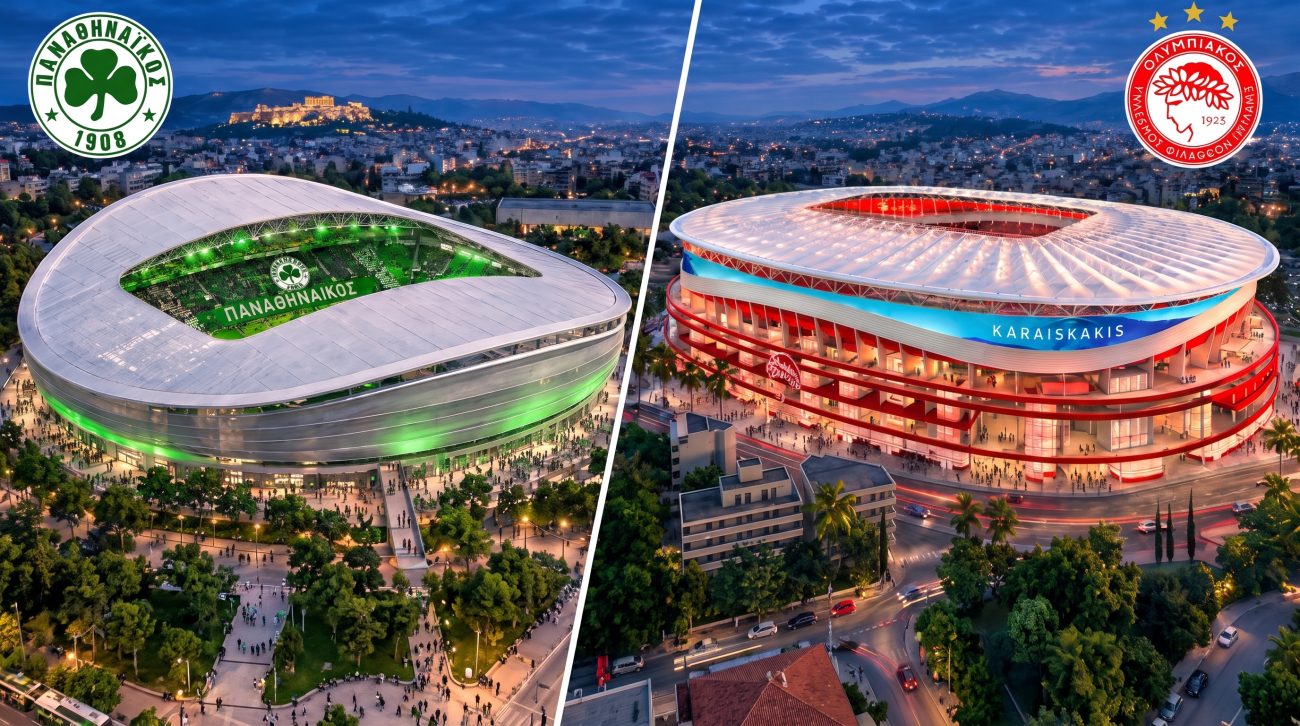
Two of Greece’s biggest football clubs are building new stadiums at the same time, and they’ve chosen completely opposite ways to do it. Panathinaikos are getting a brand-new stadium at Votanikos for up to 40,000 fans, paid for with public money, and its roof is already going up.
In Piraeus, Olympiacos wants to turn the Georgios Karaiskakis Stadium into a 53,000-seat giant, with owner Evangelos Marinakis promising more than €250 million of private money. If both projects stay on schedule, the two rivals will even trade places at the Athens Olympic Stadium in 2027.
Here’s everything we know about both projects, including capacity, design, cost, funding and when they’ll open.
Panathinaikos’ new stadium at Votanikos
Panathinaikos have been trying to leave Leoforos Alexandras for a long time. In August 2005, the club and the City of Athens signed a first memorandum for a stadium at Votanikos, an industrial area a few kilometres from the city centre, with a concept by Manuel Salgado, the architect of FC Porto’s Estádio do Dragão. That plan collapsed. A shopping mall planned next door was challenged at the Council of State by around 130 residents. Earthworks began in 2009 but stalled in the debt crisis, and by 2013 the project had been shelved.
The idea was revived in 2019. A 99-year lease and financing agreement followed in November 2020, and club members approved the deal in March 2022. Construction finally began on 6 April 2023, with the TERNA–AKTOR–METKA consortium as contractor.
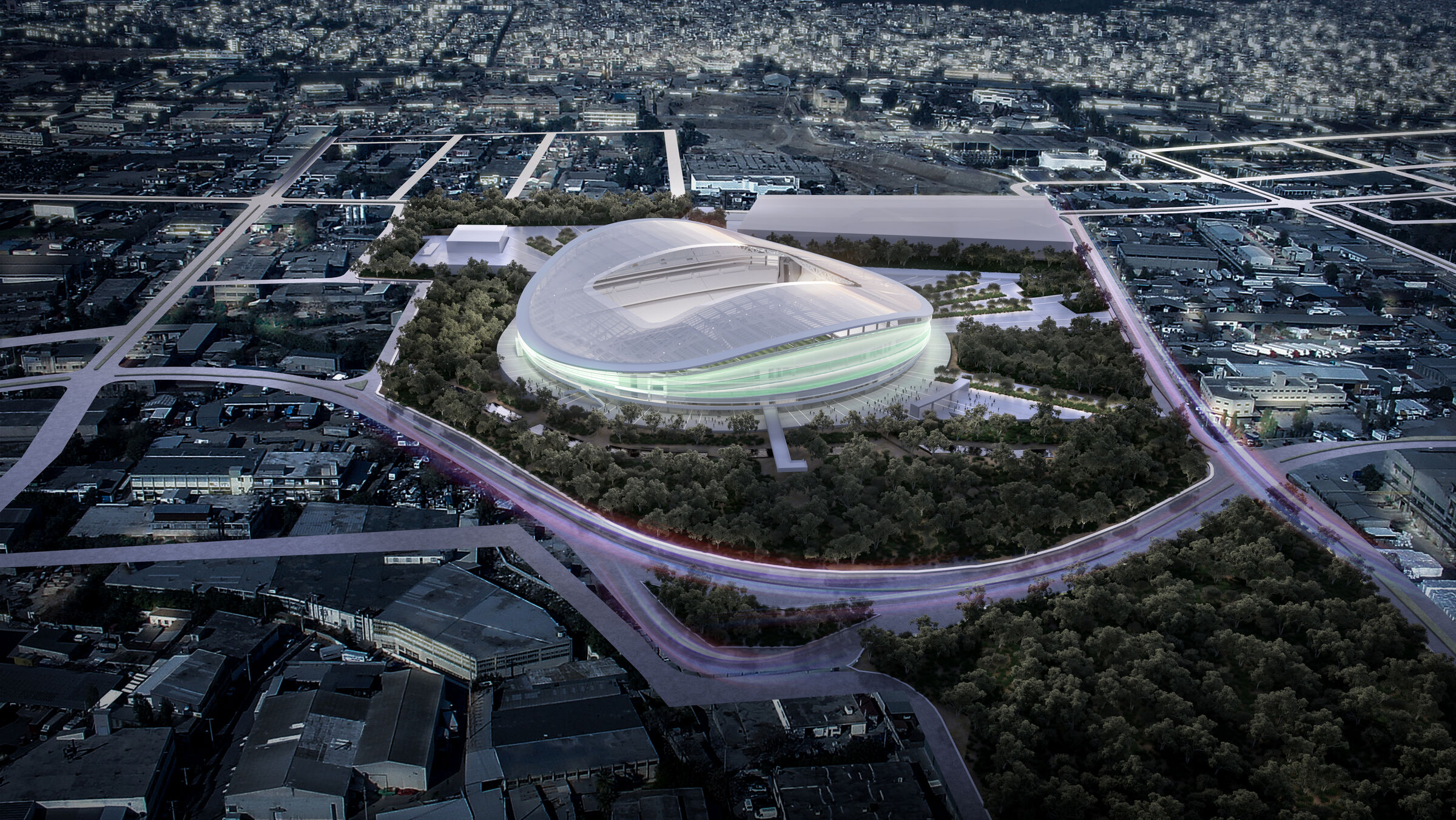 Source: https://asarchitects.gr/
Design and capacity
According to the City of Athens, the stadium will have 38,500 seats, with the option to expand to 40,000, and will meet FIFA and UEFA four-star standards. A&S Architects designed it on a perfect circular plan inspired by the Dragão, and describe its white, rounded shape as an abstract sculpture in the landscape. The roof will cover every seat. It rests on four corner pylons and steel trusses up to 160 metres long and 400 tonnes in weight, supplied by the Italian firm Maeg Costruzioni. Athens mayor Haris Doukas says the stands will look towards the Acropolis.
Facilities
The stadium includes 1,300 seats in hospitality suites, 325 underground parking spaces and seven retail units. Alongside it, the Panathinaikos multi-sport club gets a 3,100-seat indoor arena for volleyball, basketball, futsal, handball, wheelchair basketball and artistic gymnastics, plus an Olympic-size swimming pool. Doukas says the surrounding park will be one and a half times the size of Athens’ National Garden, with ten rain gardens to manage storm water.
Cost, funding and naming rights
The stadium is a City of Athens project, part of the wider Double Regeneration of Votanikos and Alexandras Avenue. Doukas has said €250 million is committed to the whole redevelopment: €140 million from the EU’s Recovery and Resilience Facility and €110 million from Greece’s Public Investment Programme. In return, Panathinaikos hand over Leoforos, valued at around €40 million.
The stadium contract has grown since it was signed in May 2023, from €119.99 million to €156.91 million including VAT, roughly 31% more. In November 2026, Panathinaikos announced a naming rights deal with Greek betting company Novibet, reported at more than €50 million over seven years, from summer 2027 to summer 2034. According to the Greek news agency ANA-MPA, it’s the biggest stadium naming deal in Greek football, and the City of Athens is expected to receive about €1.5 million a year from it.
When will it open?
The original target was July 2026. The current target is April or May 2027, with Panathinaikos moving in for the 2027–28 season. The first roof sections arrived on site on 27 October 2026, and owner Giannis Alafouzos has promised that “the stadium will be delivered by May 2027.”
What happens to Leoforos Alexandras?
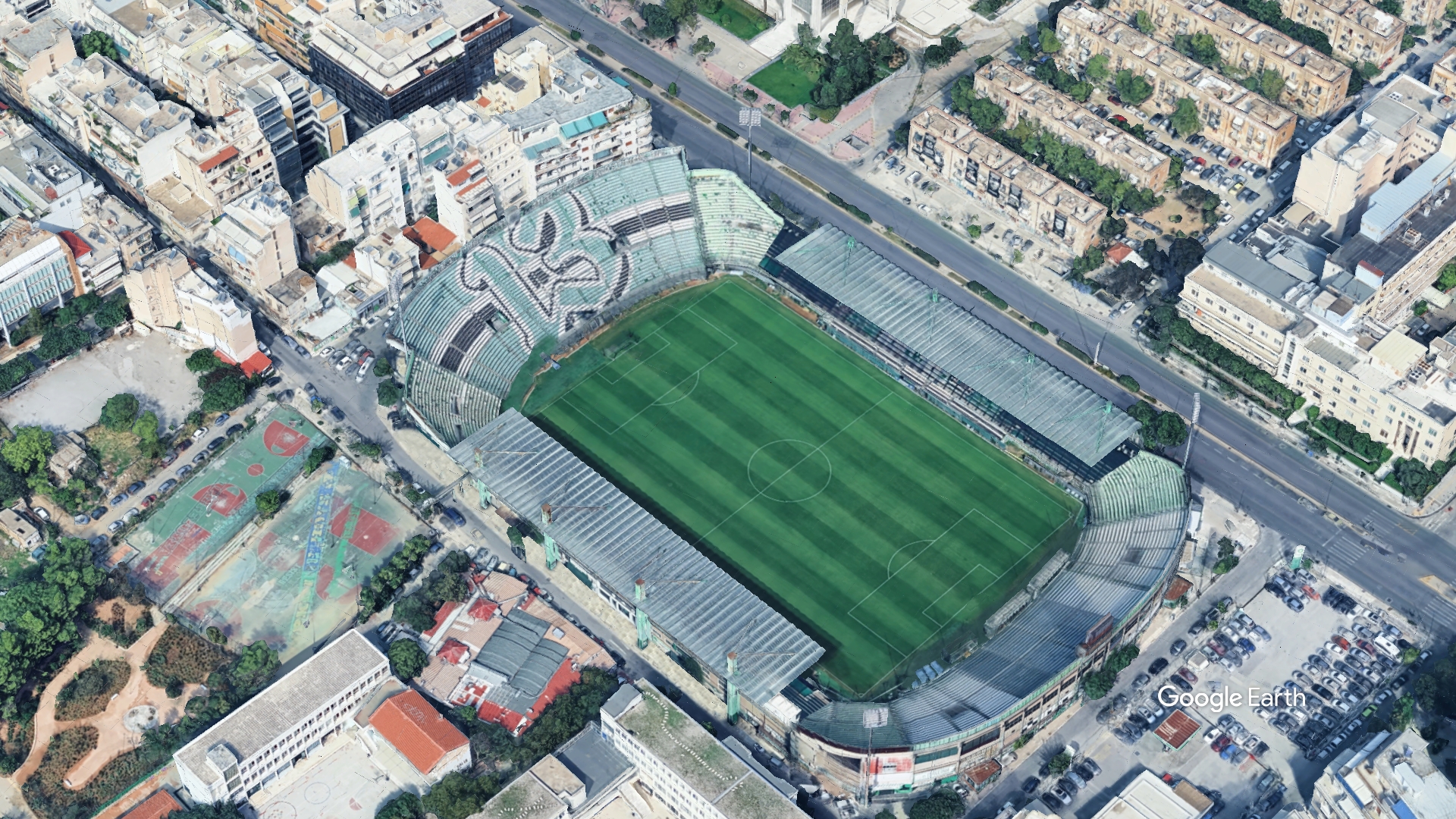
Leoforos Alexandras opened in 1922 and is the oldest active football stadium in Greece, but it holds just 16,003 fans, and since 1984 Panathinaikos have moved back and forth between Leoforos and the Athens Olympic Stadium. Under the Double Regeneration, the site will become a green space of around 18,000 square metres, with a Panathinaikos sports museum, a club lounge and an underground car park for up to 700 vehicles. Demolition can only go ahead once Votanikos is complete, and Doukas has said he believes one stand, Gate 13, should be kept.
Olympiacos’ plan for a new Karaiskakis
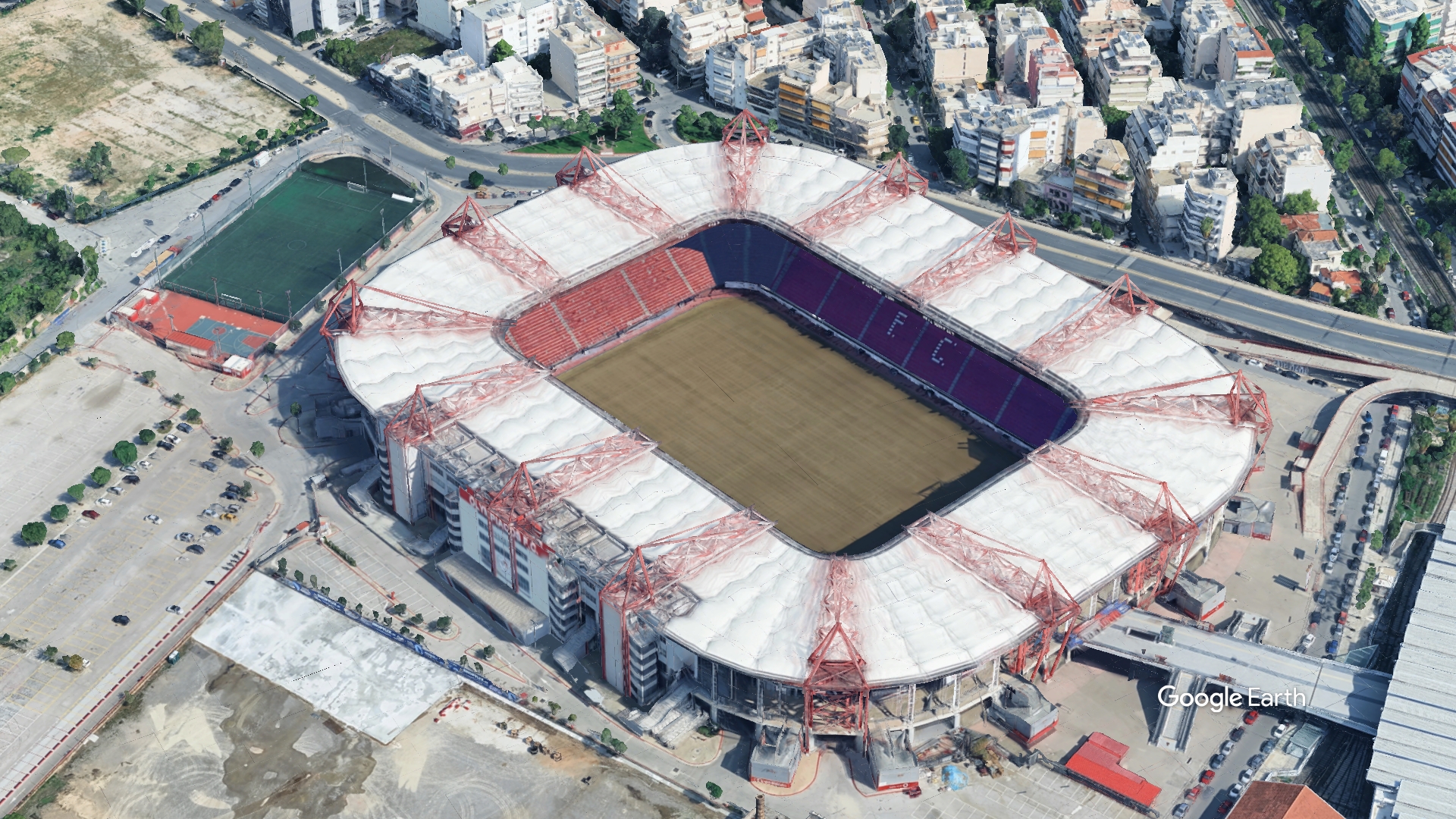
The Georgios Karaiskakis Stadium in Neo Faliro began life as a cycling velodrome for the 1896 Athens Olympics and was rebuilt and renamed in 1964. On 8 February 1981, 21 people died in a crush at Gate 7, a tragedy the club still marks every year. The current stadium was built in just 14 months and completed on 30 June 2004 at a cost of about €60 million. It holds about 33,500.
The Neo Karaiskaki plans
On 2 July 2026, at the Piraeus Municipal Theatre, Evangelos Marinakis unveiled plans for a rebuilt stadium with more than 53,000 seats, which would make it the largest football-only stadium in Greece. He said the current ground “can no longer accommodate the team we dream of,” and that the cost of more than €250 million will be covered by the club and by him personally: “No state funding has been requested, none has been granted, none will be granted, and not a single Greek taxpayer will bear any financial burden.”
Club materials promise more than 10,000 square metres of LED screens, billed as Europe’s largest integrated stadium LED system, along with more than 100 luxury suites, 70 access gates and 60 elevators. The stadium would be used year-round, for concerts and conferences as well as football.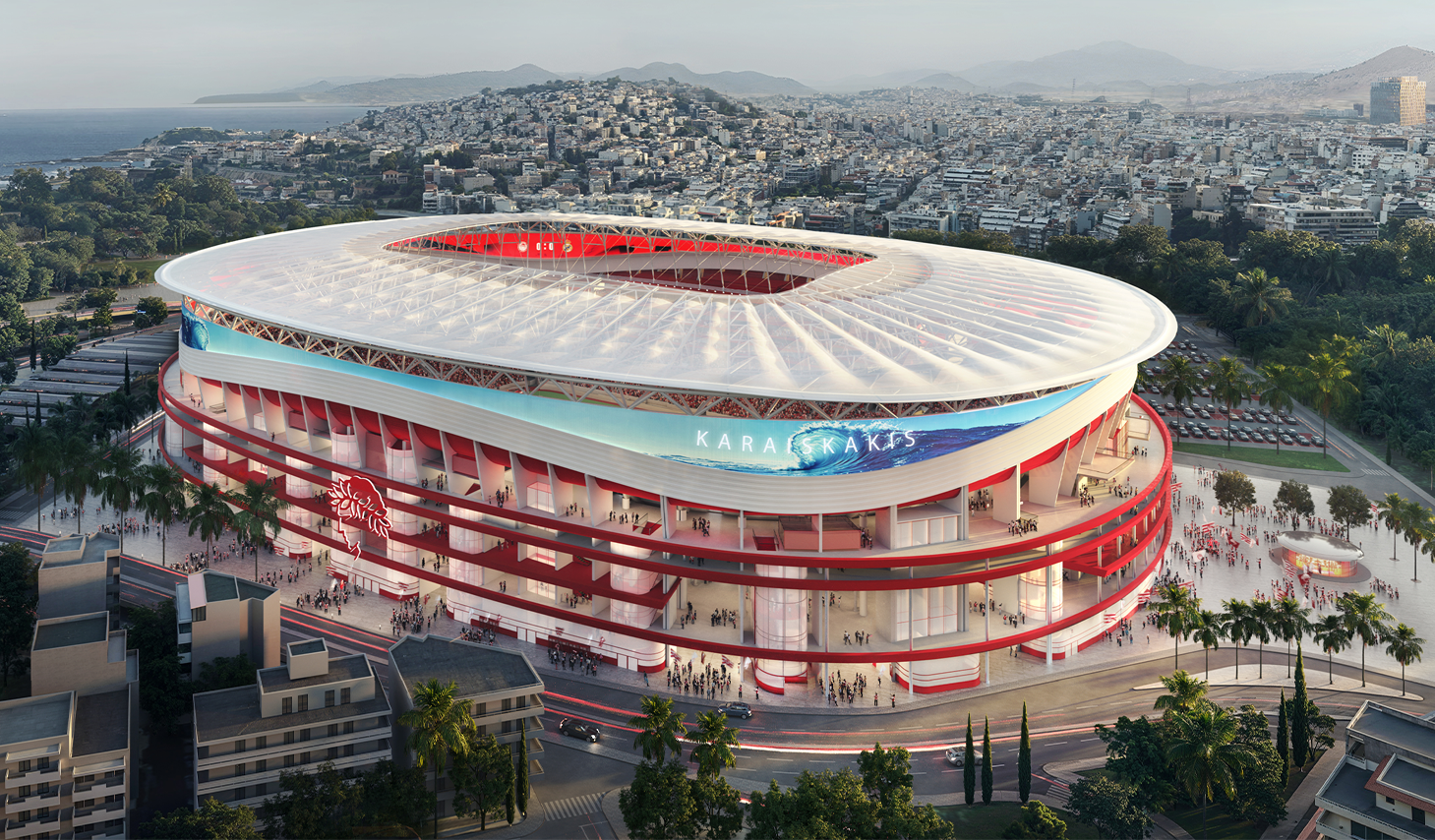 Source: https://www.olympiacos.org/
The new law and a 49-year concession
Olympiacos started pushing for a change to the stadium’s height limits in September 2025. In July 2026, the Hellenic Olympic Committee, which owns the ground, unanimously backed the new rules. That same month, Marinakis complained that “one entire year has already been lost for no reason.”
On 11 November 2026, Greece’s parliament passed the legislation. It sets the capacity at 52,000, slightly below the club’s own figure, and grants Olympiacos a new 49-year concession that replaces the 2003 deal. The club pays all construction and running costs, and the stadium returns to the Hellenic Olympic Committee at the end of the term.
When will the new Karaiskakis open?
A signed contract, updated environmental terms and a building permit from Piraeus are still needed. Prime Minister Kyriakos Mitsotakis has said the aim is to start work in May 2027, and Marinakis expects the build to take two years and three months. Olympiacos are expected to play at the Athens Olympic Stadium for about two seasons and return around the 2029–30 season. Marinakis has said that with earlier approvals, the stadium could have opened in August 2028.
The 2027 OAKA swap
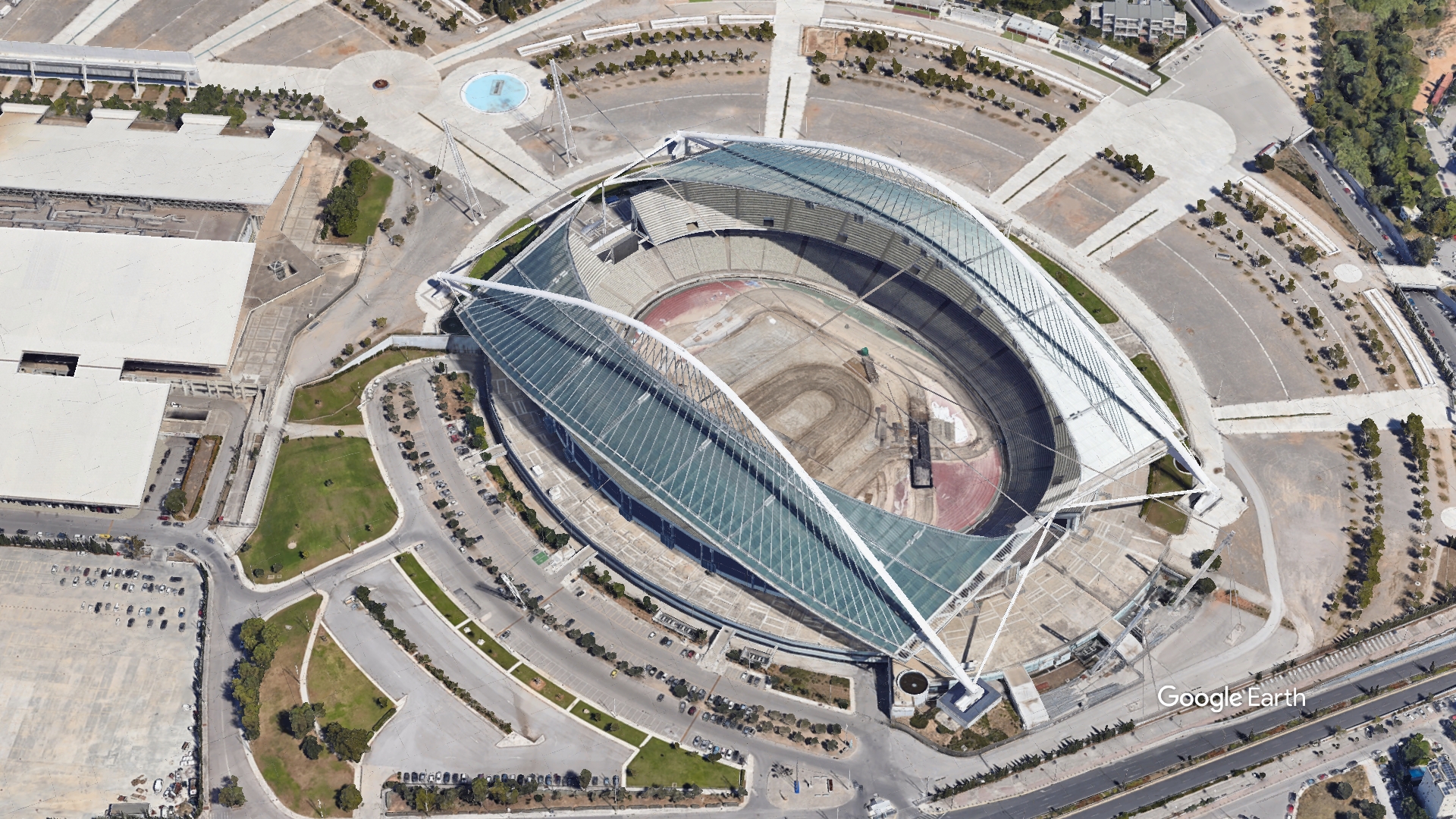
The Athens Olympic Stadium, opened in 1982 and holding about 69,600, sits at the centre of both plans. Panathinaikos are playing there in 2026–27 and are due to leave for Votanikos in 2027.
If Olympiacos start work on schedule, they’ll move into OAKA for about two seasons, and Marinakis has said no other venue can hold their fans. By the end of the decade, Athens could have two new stadiums for two of its biggest clubs.
FAQs
When will Panathinaikos’ new stadium open?
Construction is due to finish in April or May 2027, with Panathinaikos moving in for the 2027–28 season.
What is the capacity of the new Panathinaikos stadium?
According to the City of Athens, it has 38,500 seats and can be expanded to 40,000.
How many seats will the new Karaiskakis have?
The law passed in November 2026 sets the capacity at 52,000, while Olympiacos have promised more than 53,000.
Who is paying for the new Karaiskakis?
Olympiacos and owner Evangelos Marinakis are covering the cost of more than €250 million, with no state funding.
Where will Olympiacos play while Karaiskakis is rebuilt?
They’re expected to play at the Athens Olympic Stadium (OAKA) for about two seasons.
What will happen to Leoforos Alexandras?
Once the Votanikos stadium is finished, the site will become a green space with a Panathinaikos museum, a club lounge and underground parking.