The state of football infrastructure in Italy has long been a subject of intense debate and frustration. As the Italian Football Federation (FIGC) prepares to co-host the UEFA Euro 2032 tournament alongside Turkey, the nation is under immense pressure to provide at least five fully modernized, UEFA-compliant stadiums by 2026. Failure to do so risks stripping Italy of its hosting duties. Across the peninsula, major metropolitan projects are stalled. In Milan, the iconic San Siro has been classified as a historic monument, effectively paralyzing plans for demolition, while in Naples and Florence, modernization efforts have been suffocated by political controversies and a lack of public capital.
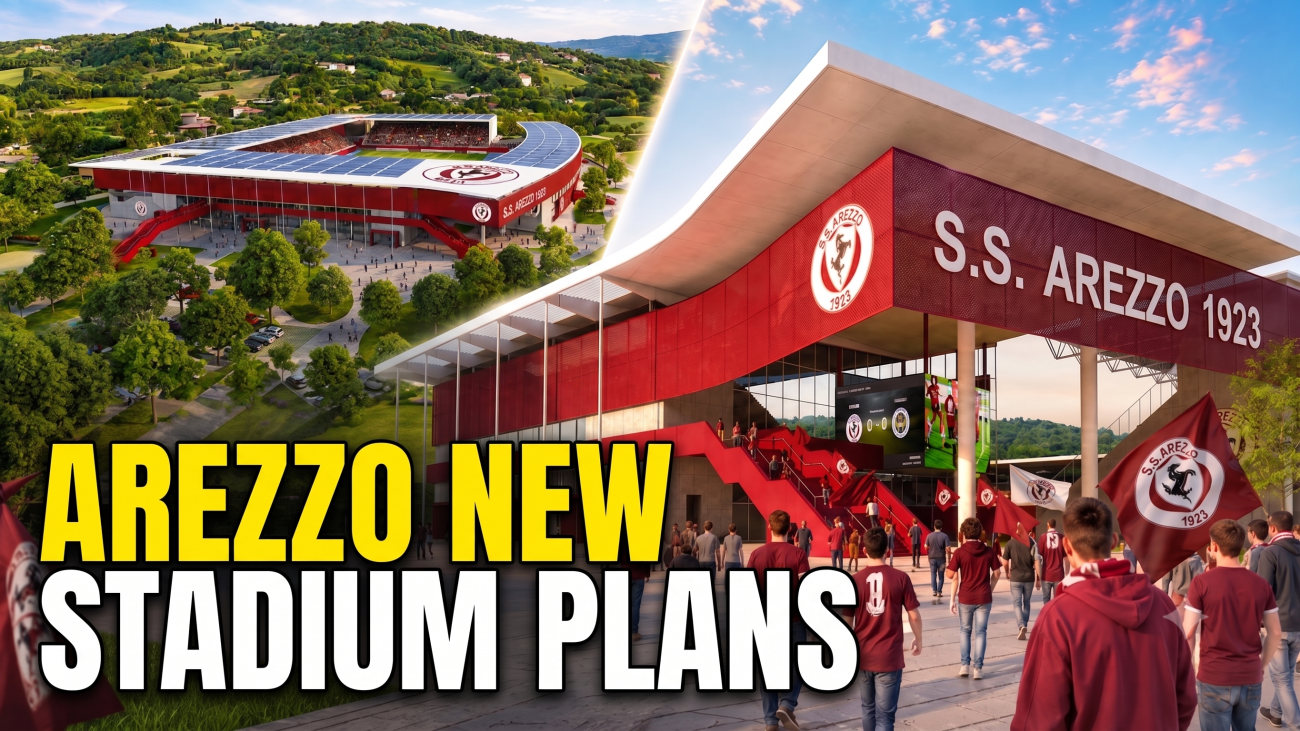
Yet, the solution to Italy’s infrastructural crisis is not emerging from its massive northern metropolises, but rather from a mid-sized municipality in Tuscany. Società Sportiva (S.S.) Arezzo is embarking on a €48.28 million, privately funded redevelopment of the Stadio Città di Arezzo. This project is poised to become a vanguard model for urban sports infrastructure, demonstrating how a football club can entirely transform an obsolete public asset without burdening the taxpayer.
The Sporting Catalyst: Ending a 19-Year Exile
Major infrastructural transformations require a powerful catalyst. For S.S. Arezzo, this momentum was generated by a historic resurgence on the pitch. The 2025-2026 Serie C campaign saw the “Amaranto” execute a dominant season under the tactical guidance of head coach Cristian Bucchi. The squad’s offensive efficacy was spearheaded by Pietro Cianci and Emiliano Pattarello, affectionately dubbed the “twins of the goal,” who consistently dismantled opposing defenses throughout the year.
The culmination of this sporting renaissance arrived on April 26, 2026. Inside a sold-out Stadio Città di Arezzo, with nearly 8,000 passionate supporters in attendance, Arezzo secured a decisive 3-1 victory over Torres. Goals from Camillo Tavernelli, a spectacular curling left-footed strike from Alessandro Arena, and a stoppage-time finish from Pattarello cemented the triumph. This victory allowed Arezzo to close the season with 80 points, narrowly eclipsing a fierce late-season challenge from Ascoli, who finished with 77 points.
The promotion to Serie B ended a grueling 19-year exile from the second tier of Italian football—a drought stretching back to the era when the club was managed by future elite tacticians Antonio Conte and Maurizio Sarri. For Club President Guglielmo Manzo, the promotion was just the beginning. Harboring long-term ambitions to reach Serie A, Manzo recognized that sustained sporting success requires a modern revenue engine that cannot rely solely on matchday ticket sales.
Transitioning to the “English Model”
 Source: m28studio
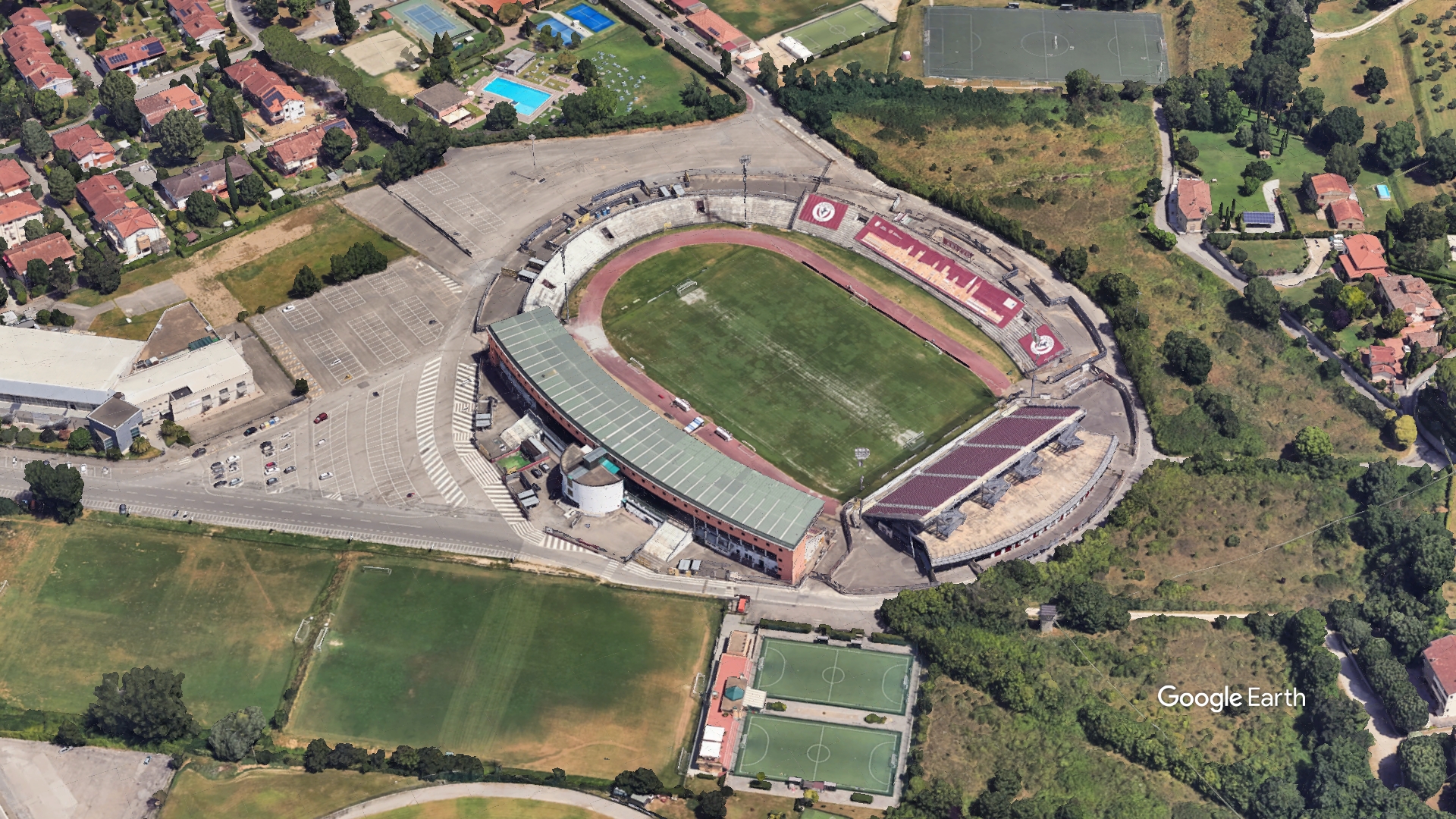
To secure the club’s financial future, management had to address the historical and structural legacy of its existing facility. Inaugurated in 1961, the original Stadio Città di Arezzo was built around a sprawling athletics track, a mid-century design choice that fundamentally compromised its utility as a pure football venue by distancing spectators from the playing surface and deadening crowd noise.
The new architectural plan, spearheaded by Rome-based M28Studio in collaboration with Studio SPSK and the engineering firm SPERI S.p.A., represents a decisive repudiation of the multi-sport bowl in favor of the highly specialized “English model”. The foundational premise of this design is the absolute maximization of physical and sensory proximity between the fans and the athletes. The athletics track will be completely eradicated.
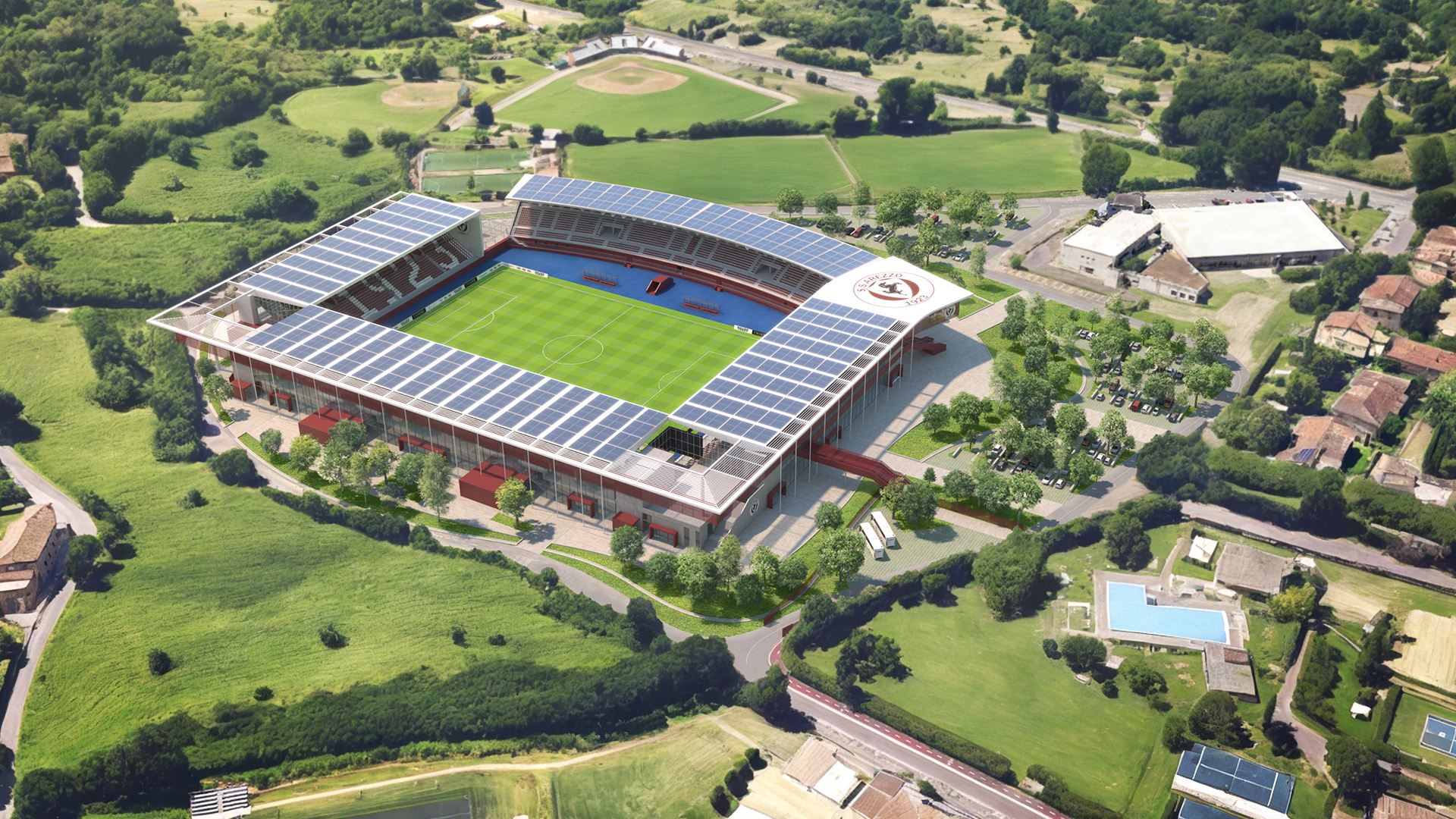
The stadium’s reconfiguration is highly strategic. Three sides of the venue—the North Curve, the South Curve (Curva Minghelli), and the East Maratona Stand—will be entirely demolished and replaced by steep, rectilinear tiers that tightly hug the perimeter of the pitch. The main West Stand (Tribuna Ovest) will be structurally preserved but subjected to a comprehensive aesthetic and functional modernization. By compressing the internal volume of the stadium and uniting it under a single, technologically advanced canopy, the architects are engineering an acoustic pressure chamber designed to trap vocal energy and amplify the home-field advantage.
The facility will feature a highly optimized capacity of 12,926 fully covered seats, balancing affordable admission with high-yield premium hospitality. The newly rebuilt Maratona Stand will serve as the commercial engine, housing over 40 luxury skyboxes. Furthermore, the introduction of 116 ultra-premium “Field Boxes” positioned directly adjacent to the playing surface will offer an immersive VIP experience entirely new to the club’s commercial portfolio.
A 365-Day Civic Utility
A critical vulnerability of 20th-century sports architecture was the creation of single-use structures that remained dormant for the majority of the year. Architect Carlo Antonio Fayer and his team explicitly designed the new stadium as a multidimensional civic space, engineered to function 365 days a year.
By eliminating the vast spaces previously occupied by the athletics track, the club is reclaiming prime real estate for commercial integration. The architectural programming includes approximately 2,000 square meters dedicated exclusively to food, beverage, and retail operations, featuring a panoramic restaurant and a diverse food hall accessible to the general public year-round. An additional 800 square meters will house corporate offices, private services, and modular areas designed for cultural, corporate, and social events.
The integration extends seamlessly into the surrounding urban landscape, where a flexible “green ring” will completely encircle the infrastructure. This urban park is designed to transition fluidly between event-day parking, pedestrian thoroughfares, and a recreational public square for the community. Ecologically, the stadium will operate at the vanguard of sustainability, featuring a 1.3 Megawatt-peak (MWp) photovoltaic solar array integrated into the roof to achieve energy self-sufficiency. This array will power the facility and act as the foundational asset for a Renewable Energy Community, feeding surplus electricity back into the local grid to suppress energy costs for the surrounding neighborhood. Furthermore, the grounds will feature advanced plumbing infrastructures designed to harvest, filter, and reuse rainwater and greywater, drastically reducing the facility’s draw on the municipal potable water supply.
Financial Engineering and the 2021 Stadium Law
The rapid progression of the project is a triumph of legislative navigation, serving as the premier case history for the application of the Italian “Legge Stadi” (Stadium Law), formalized under Legislative Decree 38/2021. This legislation was specifically engineered to dismantle the bureaucratic paralysis that has historically stifled infrastructure development in Italy, imposing highly compressed, non-negotiable timelines on public administrations.
The financial viability of a €48.28 million private investment demands absolute legal certainty. To provide this, the Municipality of Arezzo drafted and approved a convention granting S.S. Arezzo the surface rights (diritto di superficie) to the stadium for a continuous duration of 90 years. At the conclusion of this 90-year epoch, the fully modernized and capitalized asset will revert back to the public ownership of the municipality without any financial burden to taxpayers.
To execute this massive undertaking, the legal framework mandated the establishment of a “Società di Scopo,” or Special Purpose Vehicle (SPV). This distinct corporate entity intentionally isolates the financial, construction, and real estate management risks of the stadium project from the inherently volatile sporting operations of the football club. Backed by mandatory surety bonds and comprehensive insurance policies guaranteed by President Manzo, the SPV gains full managerial autonomy to exploit all commercial revenues, including food and beverage leases and the highly lucrative sale of the stadium’s naming rights.
Logistical Execution: Rebuilding Without Relocating
The most daunting logistical challenge inherent in the redevelopment of existing sports infrastructure is the imperative to maintain operational continuity. Relocating a professional football team to a neighboring city for the duration of a multi-year construction project severely damages matchday revenues, disrupts the competitive environment, and alienates the fanbase.
To prevent this, the engineering team authored a highly sophisticated, five-year phased construction schedule. This sequencing ensures that S.S. Arezzo will not be required to relocate a single home fixture throughout the entire 2026-2030 construction period.
Construction officially commenced on June 1, 2026, marked by a ceremonial ribbon-cutting and the symbolic first strike of a pickaxe against the old Maratona curve—an event attended by President Manzo, Mayor Alessandro Ghinelli, and the President of the Tuscany Region, Eugenio Giani. Between 2026 and 2028, efforts will focus heavily on the demolition and reconstruction of the Maratona Stand and the Away Sector. The complex shifting of the playing pitch has been strategically delayed until the summer of 2027 to prioritize concrete pouring for the new stands. Later phases, stretching from 2029 into late 2030, will tackle the demolition and reconstruction of the Curva Sud Minghelli and the final aesthetic restyling of the central West Stand.
The Blueprint for the Future
The redevelopment of the Stadio Città di Arezzo stands as a landmark achievement in Italian civic infrastructure. The leadership of S.S. Arezzo has orchestrated a project that transcends traditional football management.
At a time when major metropolitan projects are paralyzed by political inertia, the “Arezzo Model” illuminates a clear, legal, and highly lucrative path forward. By leveraging the expedited frameworks of the Legge Stadi, securing a 90-year concession, and deploying private capital, the club has successfully severed infrastructural development from municipal bureaucracy. As the phased construction progresses toward its 2030 completion, it will undoubtedly serve as the definitive blueprint for the commercial, structural, and environmental future of Italian sports infrastructure.